Crypto, three coins Altcoin Daily flags as breakout candidates
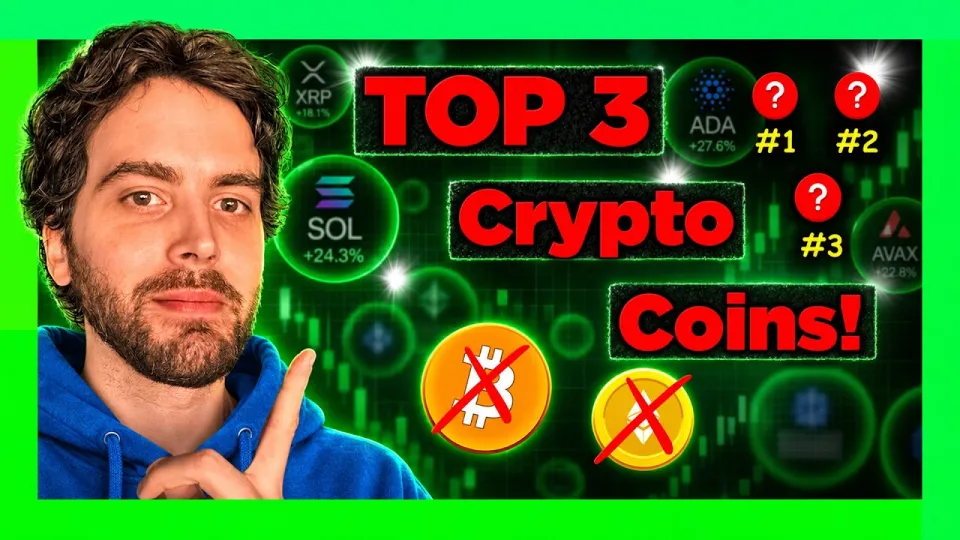
Video: These 3 Crypto Coins Are Getting Ready To EXPLODE!?
Need articles like this for your video? They help promote it on YouTube and Google — order them in the Telegram bot @sat_sit_bot. It writes articles around your video, embeds the video and publishes them on popular niche websites (no ads). Try it free: 50 articles on us.
Key takeaways
- Altcoin Daily's shortlist of three breakout candidates centres on Solana, Hyperliquid and NEAR Protocol.
- Solana is framed as the retail-facing layer-1 with the deepest app ecosystem and the Backpack wallet connection.
- Hyperliquid is treated as a perp DEX plus its own chain, competing on order-book speed rather than TVL marketing.
- NEAR is pitched as the AI-adjacent chain with chain abstraction, and one viewer expects $15 per coin this cycle.
- Viewer debate also covers TAO, Midnight, Zcash, Sonic and Arbitrum gas costs, none of which made the top three.
The crypto shortlist in Altcoin Daily's breakdown is Solana, Hyperliquid and NEAR Protocol: three assets the channel frames as being set up for a sharp move rather than a slow grind. The argument rests on usage and narrative fit — Solana's consumer app base, Hyperliquid's on-chain order book and NEAR's AI positioning — not on price targets. You can follow the channel's ongoing coverage through Altcoin Daily on X.
What the crypto shortlist actually claims
The core claim is that these three coins combine real on-chain activity with a narrative the market can price. Solana is presented as the retail layer-1 where wallets, memecoins and trading apps actually live; Backpack is named as the wallet tied to that story. Hyperliquid is described as a perpetuals exchange that runs its own chain, so fees and liquidity stay inside its ecosystem instead of leaking to a general-purpose network. NEAR is the AI-adjacent pick, with chain abstraction — one account across multiple chains — as the differentiator.
The framing matters more than the tickers. Each pick has a demand driver that is not simply "the next bull run": consumer app flow, trading volume, or developer tooling for cross-chain UX. That is the test to apply to any crypto list, including this one.
Solana: the retail liquidity case
Solana's pitch is that it is where new users and new tokens actually land. The channel treats the chain as the default home for consumer crypto — wallets like Backpack, token launches, and the trading apps that dominate retail attention. That flow is the argument: an asset that captures retail activity tends to move faster than one that only captures developer mindshare.
The risks are equally concrete. Solana has a history of congestion during demand spikes, and its price is heavily correlated with the broader crypto risk cycle. A breakout thesis built on app usage breaks down if usage stalls or if fees spike during the exact moments volume arrives.
Hyperliquid: a perp DEX that owns its chain
Hyperliquid's case is that it competes with centralised exchanges on execution rather than on marketing. It runs a perpetual futures order book on its own chain, which means trading fees and liquidity incentives stay within the protocol instead of being paid out to a host network. For traders, the practical appeal is speed and a familiar order-book interface rather than an AMM curve.
That model cuts both ways. A perp DEX is levered to trading volume, so quiet markets hurt revenue directly, and the token's value depends on how fees and incentives are routed. Viewers also push back on cost: one notes that Arbitrum is cheaper than Hyperliquid for gas. That is a fair comparison for small trades, though it measures fees, not order-book depth.
NEAR Protocol: AI narrative plus chain abstraction
NEAR is the pick with the most story attached. The channel links it to AI-adjacent development and to chain abstraction, the idea that a user should not have to think about which network they are on. In practice that means one account and one balance that can operate across chains, which is a UX argument rather than a throughput argument.
Viewer sentiment is unusually warm here: several comments say NEAR has repeatedly rescued their portfolios, and one expects it to reach $15 per coin this cycle. Treat that as sentiment, not analysis — a $15 target is a claim about market cap and supply, and the channel itself does not commit to a number.
Questions and doubts from the crypto audience
Viewers rarely argue about the shortlist itself; they argue about what is missing from it. The recurring themes:
- AI coins. TAO (Bittensor) draws the most enthusiasm in the comments, and its absence from a three-coin list is the most common complaint.
- Privacy. Midnight and Zcash both come up repeatedly, with viewers ranking them against each other and against NEAR.
- Other layer-1s and layer-2s. Sonic (formerly Fantom), Arbitrum and Ondo all get named as alternatives, along with Aerodrome and Plume.
- Seasonality. One comment mocks the "Uptober" ritual, noting that October has repeatedly failed to deliver the rally the nickname implies.
- Follow-ups. A holder asks whether an earlier pick, Concordium, still has the channel's support — a reminder that a three-coin list is a snapshot, not a portfolio.
How to use a three-coin crypto list
A shortlist like this is a starting point for research, not a buy signal. Three practical filters:
- Check the usage claim. For Solana, look at active addresses and app fees. For Hyperliquid, look at perp volume and open interest. For NEAR, look at developer activity and cross-chain integrations.
- Check the token's cash flow. Ask whether fees, emissions or buybacks actually reach the token, and under what conditions.
- Size for volatility. These are high-beta assets; a breakout thesis and a 40% drawdown can coexist in the same quarter.
Links from the video
- Altcoin Daily on X — the channel's ongoing coverage and commentary.
- WEEX welcome event — a 50% deposit bonus on a first $100 deposit, promoted in the video.
Bottom line
Altcoin Daily's three-coin crypto shortlist — Solana, Hyperliquid and NEAR — is a coherent set: each pick has a usage story that can be checked on-chain rather than a pure narrative bet. The audience's counterarguments are worth taking seriously, particularly on AI exposure through TAO and on privacy names like Midnight and Zcash. Use the list as a research queue and verify volume, fees and token flows before sizing any position. For more breakdowns in this format, the channel Altcoin Daily on X is where the follow-up discussion happens.
Source: These 3 Crypto Coins Are Getting Ready To EXPLODE!? · Markdown version
Questions & answers
Which three coins does Altcoin Daily name as breakout candidates?
The shortlist is Solana, Hyperliquid and NEAR Protocol. Solana is framed around retail app activity and wallets like Backpack, Hyperliquid around its own-chain perpetuals order book, and NEAR around AI-adjacent development plus chain abstraction.
Why do viewers keep mentioning TAO and Midnight if they are not on the list?
A three-coin format always leaves names out, and the audience fills the gap. TAO (Bittensor) is the most requested AI coin, while Midnight and Zcash dominate the privacy discussion, with viewers ranking them against each other and against NEAR.
Is Hyperliquid really more expensive than Arbitrum for gas?
It depends on the trade. One viewer notes Arbitrum is cheaper for gas fees, which is true for small transactions on a general-purpose layer-2. Hyperliquid's case is order-book depth and execution speed for perpetuals, not the lowest possible fee per transaction.
Can NEAR realistically reach $15 this cycle?
That figure comes from a viewer, not from the channel, and it implies a large jump in market capitalisation at current supply. Treat it as sentiment: the analytical case for NEAR rests on chain abstraction adoption and developer activity, which can be tracked on-chain rather than assumed.